
Email is how we communicate good news, bad news, progress, ideas, and new connections. I write often about how to write an email with your reader in mind, how a well written and structured email could replace a pointless meeting, or how to fine tune your messages for busy executives. This time, I want to talk about the other side of email that makes it challenging…responsiveness. How, when, what, and if your recipient responds is essential to how you work.
I think there are two areas where this shows up, and paying attention to both can help you recognize patterns that signal dependability, consistency, accountability — and the other side: unreliable, inconsistent and excuse-driven. The first is the email response itself. The second is the meeting follow up email.

I’d like to introduce the idea of email response archetypes — recognizable communication patterns, not fixed labels — and I believe we can apply them here to learn a little about ourselves and our contacts along the way.
The archetypes
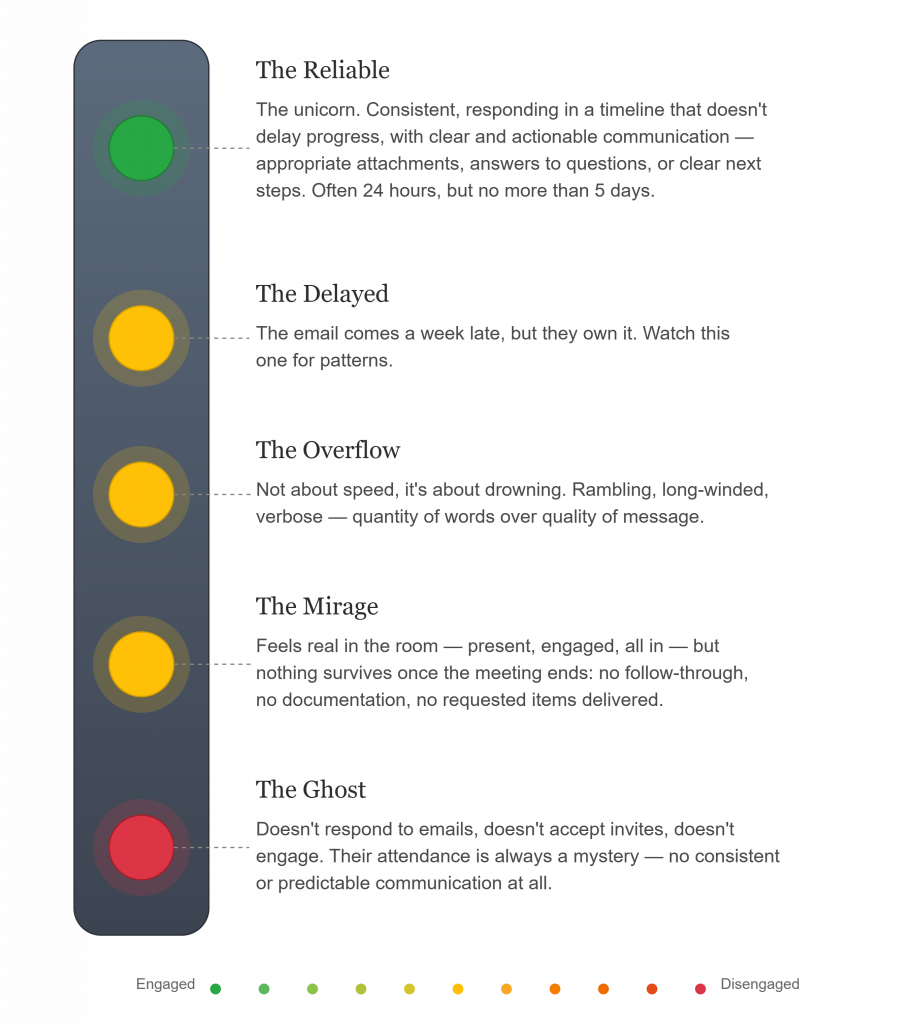
It’s situational, not personal
These archetypes aren’t necessarily tied to a fixed communication pattern — sometimes they are situational. When in crisis, many things that aren’t related to the emergency will push communication into the yellow or red. And a shift in priorities can take a consistent Reliable and turn their communication style into a Mirage. The key is to recognize patterns and act accordingly — it’s not about confronting your contacts, it’s about managing your energy and putting it where it’s best served. Think about how much better your day will go if you stop chasing a response from The Ghost, or desperately trying to nail down action items after yet another great meeting with The Mirage. True, we don’t all have the luxury of walking away from a prospect who’s stopped responding, but we do have the ability to stop going down the same path and expecting a different result.
Here are a few scenarios where this plays out.
Scenario 1: When a mission-driven organization runs a lean team, one integral person leaving — due to resignation, medical leave, whatever the reason — means all hands on deck, and the impact can be felt throughout. Your contact is unexpectedly putting out fires, and the response you’re waiting on just isn’t the priority it was last week.
Scenario 2: Sometimes the shift has nothing to do with work at all. A vacation, a new baby, a flooded basement, a family emergency — life happens, and the response you were counting on takes a back seat to whatever’s happening at home.
Scenario 3: Other times, the disruption comes from outside entirely. Lost funding, a security breach, an unexpected audit — the organization shifts into damage control, and nothing takes priority over resolving it.
Scenario 4: The change happens before you even know why. Your contact may already know they’re moving into a new role, but they can’t say so until it’s announced — and even after it is, the seat they’re leaving might stay empty until a replacement is named.
These are the moments that explain a dip, a break in the norm — the reasons a Reliable’s communication style shifts toward Mirage for a while. But if none of these are in play, and the pattern keeps repeating anyway, that’s when it’s time to manage your energy and effort.
When it’s not the exception, it’s time to change the rules

Start by shifting where you put your energy and effort. Managing your expectations, communication style and engagement can be key to avoiding unnecessary stress. Getting upset because you’ve not heard back, a manager doesn’t accept or attend a meeting…again… You can’t control anyone else’s behavior or how they respond to you. What you control is how much attention you give to folks who are consistently in the yellow and red. Below are tips on how to refocus your energy in these situations:
The Delayed — start using timeframes in your communication. Decisions need to be made by X date, please respond by X PM with concerns. Include it in your subject line and body of your email. When the date comes and goes, you can proceed and justify why you proceeded.
The Overflow — one topic per email. Don’t ask more than one question in an email if you tend to get a novel back. I wrote more on this in Audience-Centered Communication Strategies — one subject, one email, every time.
The Ghost — after a reasonable number of attempts, either let the contact go or loop in someone else on their team. Before doing either, include their supervisor on your last attempt, with the full thread attached showing the effort. You may find one of the scenarios above explains the silence, or you’ll get rerouted to someone who can actually help.
The Mirage — when these archetypes impact progress following meetings, you can choose to be the scribe who documents the meeting and follows up. The key is documenting what was agreed to, decisions that were made, and action items. If the Mirage doesn’t rebut your documentation, it becomes record.
The Reliable — match their consistency. Be clear in your responses and timely in your delivery. You can show appreciation for a good contact simply by being one yourself — consistency is a two-way habit, not just something you notice in others.
Notice the pattern, protect your energy
These five patterns aren’t about labeling people — they’re about noticing what’s actually happening so you can decide where to put your energy. Once you see it, for yourself, your team, and your contacts, the choice becomes a lot easier.
Leave a Reply